


Skrillex Was Never Who You Thought He Was
In the 2010s, dance music's most misunderstood star ignited a battle royale over taste. But the structural hypocrisy underneath went unexamined — until now.
Words by Whitney Wei
The first time I could truly comprehend Skrillex's artistry was at the conclusion of Harmony Korine's 2012 "beach noir" film Spring Breakers. In the final scenes, the characters Britt and Candy, portrayed by Ashley Benson and Vanessa Hudgens, don pink balaclavas and glow-in-the-dark yellow bikinis and proceed to shoot out a rival gang member's mansion. A string rendition of Skrillex’s "Scary Monsters and Nice Sprites" lends an odd poetry to the attack, crystallising the sinister undertow within the cinematic equivalent of a jawbreaker sugar rush. Against pop music orchestral swells, beachside bimbos and tacky American maximalism weren’t to be underestimated but taken dead seriously.
Sonny John Moore, better known by his EDM moniker Skrillex, was tasked with the music for Spring Breakers alongside composer Cliff Martinez, in what became the first major scoring opportunity in his career. Hearing his work in a darkened theatre within a neon-soaked satire, I suddenly recognised that Moore — who was pilloried at the time as the father of "brostep" by electronic purists and considered "the most hated man in dubstep" by The Guardian— was the linchpin of the same junk food American party culture that I also belong to. This was nothing to be ashamed of.
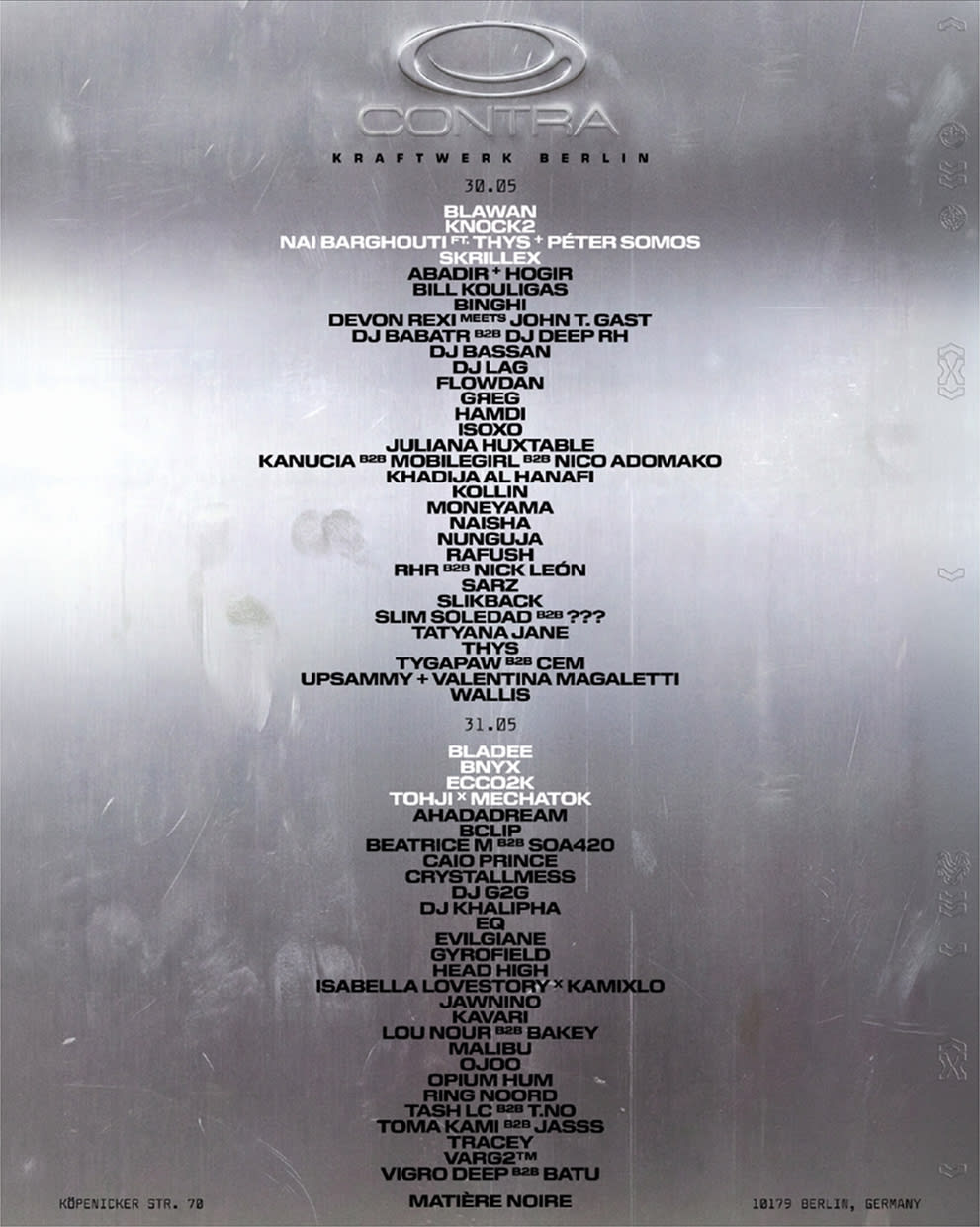
Over a decade later, in late May, he performed in Berlin's Kraftwerk for the launch of his multidisciplinary platform CONTRA. There he was as a mainstream figure in unity with the underground, uplifting the very milieu that originally shunned him. The moment revealed the dramatic repositioning of an artist who was never fully understood, arriving in a dance music scene that was at last relinquishing its old pretensions.
Skrillex’s Renewed Public Perception
CONTRA is a statement of belonging that was about four years in the making. Post-pandemic, Moore gradually cultivated his credibility within typical "underground" circuits. In 2019, he was still playing Ultra Japan and Electric Zoo, but by 2022 and beyond, started making cameos at Movement, CTM, Nuit Sonores, Sónar, Nyege Nyege festivals, and a Live From Earth showcase. This July, he's poised to play at Dekmantel.
The year 2023 was pivotal for changing perceptions around Moore: that January he released the critically acclaimed track 'Rumble,' also produced by Fred again.., a signal of his cosign by the legendary English grime MC Flowdan. To celebrate the release of his second studio album Quest for Fire that February, he played surprise back-to-back with Fred Again.. and Four Tet at The Lot Radio in Times Square, whose original location in Brooklyn is a regular underground haunt for the dance music community. After working together, Four Tet commended Moore's level of craft. "Sonny is just insane. Just watching him use Ableton is the highest level I've ever seen… it's very overwhelming actually…" he said in an interview last year. "It seems like alchemy to me."
Moore has continued to be a widely-discussed member of the electronic community, with many veteran writers revisiting their old assumptions about him now that he's collaborated in a swift, globetrotting succession with everyone from Caroline Polachek to Slikback to, most recently, Tracey and RHR. Another potential reason for this could very well be that the generation of young DJs and producers he inspired, like Nick Leon, 100Gecs, and Brutalismus 3000, have finally become influential figures in their own right. However, this newfound appreciation for Skrillex neglects to thoroughly examine the origins of the unjustified, inordinate amount of hatred and cruelty he suffered in the public just a decade prior.


Skrillex's Legacy as a Missionary of Dance Music
Reading Skrillex, so to speak, requires both American cultural literacy and an element of grace towards EDM. As the former lead vocalist of the post-hardcore band From First to Last, Moore's pivot to electronic music was a surprising one, but his sonic palette remained the same. The jagged guitars and whining vocals with punctuations of screaming turned into roller coaster adrenaline drops with growling, exorcistic synthesizers, perfectly suitable to tear up a mosh pit. It was bass music reaching peak voltage through screamo sensibility. "I always think it's fun to make sounds that almost sound human — even though they come from a computer, there's something organic-sounding about it. That's where the 'monster' thing comes from," Moore said in a 2014 interview with NPR. With it, he created an entirely new strand of electronic music, known as EDM.
There are countless articles admonishing the trashy tastelessness of 2010s EDM without examining what it did exactly right — and what Moore specifically did right — to so strongly magnetize hundreds of thousands of people. At its heart, this music exemplified everything the world loves to hate about most American inventions but can't stop talking about. It had brash, boisterous commercial polish combined with in-your-face showmanship. In the same way that deep-fried Coca-Cola or triple cheeseburger donuts seem like a bastardization of food culture, these guilty pleasures are, in fact, more compelling because they don't care to uphold the invisible rules of taste.


Skrillex successfully translated UK dubstep's nuance into an emotional language in caps lock that was legible to a generation of Americans who had little to no electronic music literacy, some of them going on to explore its underground aspects in their own right as fans, artists, and industry professionals. And for all of those legions of fans who wanted nothing more than to thrash against the metal barricades at Electric Daisy Carnival, it was perfect. Unlike in the UK, where electronic music is prominent on radio stations, it took Moore's earth-shattering drops circulating online to reach the Top 40 hinterlands of the USA, from Minnesota to Maine, and far beyond. It was many American teenagers’ first taste of metallic synthesizers that forcefully serrated their way through suburban ennui. It found a home with the Abercrombie & Fitch preps at Syracuse University as it did with the emo kids with side-parted hair and eyeliner, eating Sbarro's at the local food court.
Moore's interpretation of dubstep was the epitome of pyrotechnic entertainment that splashed around with the genre's forefathers, but without a sprig of self-consciousness or deprecation often required while "cutting one's teeth." To critics, it appeared that Skrillex just threw out the rule book, cut in front of the line, won an armful of Grammy Awards — and didn't do enough in his acceptance speech to big up the "Croydon dub guys." There was nothing more infuriating. But to whom? It was unfortunate that aspects of electronic music's origin story were left behind during its meteoric transformation, but instead of this being viewed as a potential educational opportunity for a fast-growing, curious audience, what ultimately occurred was more of a battle royale over taste.


In actuality, some of the most respected names in the genre at the time showed up in support when he played a B2B set with Caspa at Fabric. Prodigy and some of the Big Apple Records dubstep originators, namely the Magnetic Man outfit consisting of Artwork, Skream, and Benga, were all there. Skream consistently went on record to defend him.
Mala, dubstep's very own elder statesman, made his peace with the genre's unforeseen trajectory. Following its EDM detour, he was demoralized by the community's bitter outpouring. He told DJ Mag in a reflective 2021 interview, "[Brostep] made a lot of people very, very angry, and rather than looking at it like 'Look at what our small scene from London has achieved', and take it as a chance for them to evolve their own sound, a lot of people just shut down. They felt so disgruntled by this new wave of music that they ruined their own creativity by focusing on all the negative energy. It was heavy. It seemed to become about competition, with people trying to assassinate people's characters when they’re not there to defend themselves."


Brostep Was a Hypocritical Misnomer
In old reviews of "Scary Monsters and Nice Sprites," Skrillex's breakout EP, critics called his work a perversion of the introspective, minimalist dubstep that emerged from Croydon, London, by way of Jamaican sound systems. Moore's domain became "brostep," as coined by American producer Kozee on Dubstepforum. The pejorative poked fun at what she considered a hyper-extroverted genre that belonged more to fist-pumping American fraternity pledges rather than the British bass continuum. Moore once said, with a tinge of resignation, "I think 'brostep' was just a derogatory term that came from the heads, the purest dubstep fans that weren't into anything that had too much mid-range sound in it; for whatever reason, they're not into that."
Upon closer examination, 'brostep' was a huge misnomer. And the music critics who went on to weaponise and wield the term were often men who sat on majority-male editorial teams, writing on platforms intended to cultivate a Millennial male readership, altogether creating a strange structural hypocrisy. Coincidentally, the demographic for the original dubstep community was also predominantly male. Both underground and mainstream dance music have had a long history of gender disparity across festival line-ups, though these numbers tend to even out at an audience level.
The cementing of 'brostep' should not be mistaken as a move in defence of women. On a pop culture scale, those who ran with the term belong to a similar creed of old guard critics and nerd naysayers who similarly revile the taste of teenage girls. To then have pinned the pervasive issue of inequality onto one specific genre and artist fails to take accountability for the glaring misogyny everywhere else.


"At the end of the day, it's DANCE music.. dancing is supposed to be fun. Dance music should be fun to [sic]..." Moore wrote twelve years ago on his Reddit AMA, "I come from [sic] hardcore and punkrock… I came from the uncool lunch tables. I feel like there's this jock elitist mentality when it comes to dubstep in particular which is so against everything I stand for. BEING yourself, and not giving a fuck what others think. Not judging others.. For fucks it's just MUSIC. Stop taking it so seriously and have fun…"
If "bro-y-ness," as we all know it, is characterised by hypermasculinity and sexist exclusion when it comes to specific activities such as athletics, gaming, or electronic music, who in this scenario fits the patronising jock definition more? Perhaps not the artist whom everyone considers to be "such a nice guy."
And Skrillex's fans? Speaking to Dazed in 2012, he mentioned playing to a largely female crowd in Puerto Rico, and of his broad appeal as a source of pride. "I have lots of young fans, super young and then a lot older. Hip hop guys to metal chicks to dance kids to whoever," he said. The controversy around brostep also casts a long shadow over the wide breadth of genres he's always incorporated into his productions, like hip-hop, techno, and moombahton in the 2010s and Brazilian funk, Miami bass, trance, and techno on his most recent release SOMA.

The Dance Music Power Struggle
There was a deeper reason for all the purist vitriol. During the 2010s, the music media landscape was drastically changing. In Skrillex's own words, "Nobody is going to places like MTV to find new music. You go to the internet and discover it yourself." It was the heyday of "hipster" music press, a time when Pitchfork was accused of being pretentious and mean-spirited to any artist remotely popular, and other music media followed suit. This occurred simultaneously with SoundCloud rapidly overtaking MySpace as a hub for music discovery and artist promotion, both platforms being Skrillex's preferred mediums for dropping free downloads and unreleased tracks. By daring to bypass the approval of cultural gatekeepers, the close-minded "jock elitists" here, Moore became persona non grata of the cafeteria. "You're always bullied if you're the emo kid," he once said.
In hindsight, this appears as a classic case of status anxiety where ingroup members aggressively demarcate an outgroup to compensate for a loss of control. Because an ingroup may have emotional attachment to certain identity markers such as authority or taste, in this case, they force a false binary categorization. What is considered "proper" or "worthy" dance music, and what isn't? Who exactly gets to make this call? The Skrillex divide is one prominent example of this, but it extends to the history of sexist and racist exclusion in dance music that eventually reached a subcultural reckoning during the #MeToo and Black Lives Matter movements towards the end of the decade into the early 2020s.
For music press at the time to express such a high degree of resentment towards Skrillex by gendering his music and severing his lineage to dubstep, it feels like a projection of the Jungian shadow. His biggest critics unconsciously scapegoated him with their deepest insecurities around inclusion and relevance. Without ever so much of a glance in the mirror, those who accused him of vulgarity were themselves performing the cruellest version of subcultural gatekeeping. "It's easy for people who feel like they don't understand something to immediately bash it because they feel they don't understand what's cool or what's new," Moore told Katie Couric in 2015. "But all I say is, if it's that easy, you can do it too then."

Ironically, Moore may very well embody the spirit of dance music far better than those who appointed themselves to safeguard it. He's been unflappably optimistic, even in the face of senseless hostility. He is a technically exceptional producer well known for his mixing. Beyond that, he's always given deference to The Bug and Aphex Twin, anything released by Warp Records, and shown social media support to such independent radio stations as Rinse FM. In hindsight, Skrillex should've been a miracle myth in the underground circuit. He was a misfit prodigy who got famous in a year from tracks he made on his laptop while living in an illegal Los Angeles warehouse.
All this is to say that the recent Skrillex revival is not the later-career pivot to respectability as it has been framed. He was always respectable, always exceedingly talented, only before he shirked the purist's stamp of approval. This recent development masks the enduring "symbolic violence" of good taste. Social theorist Pierre Bourdieu posited that a dominant ruling class narrowly defines aesthetic value to accumulate and retain cultural capital.
By restricting the distinctions of high and low or "mainstream" and "underground" forms of culture, the ruling class enforces these rigid norms onto other social classes. The oppressed individuals subsequently internalise this elitism as superior to their own, unknowingly validating the social systems that subjugated them. When the purists strangled EDM, it was truly never about good taste — it was about power, and for Skrillex, they refused to convert his talent and immense socio-economic capital into cultural currency.


Moore's persistent genre-agnosticism also points to a struggle that many underground DJs grappled with during the 'deconstructed club' era, also during the 2010s, when sets spliced together everything from cumbia to Jersey club, to flex dance music and ballroom, to grime. In Berlin, labels like PAN, who drew connections between far-flung genres and also connected electronic music with fashion, art, and design, were also met with confusion by the dance music establishment. Such a resistance to categorization demands creative, systems-based thought rather than the specialist, reductionist approach that has largely oppressed music discourse.
"This dance music thing is not a bubble," Moore once said. "Because it's not about dubstep, or techno, or house, or any other sound: those things coexist and support each other. It's not like when grunge or nu-metal or whatever became the new trend and everyone was chasing one sound and that scene turned in on itself and lost what it had to begin with. There's room for everything."
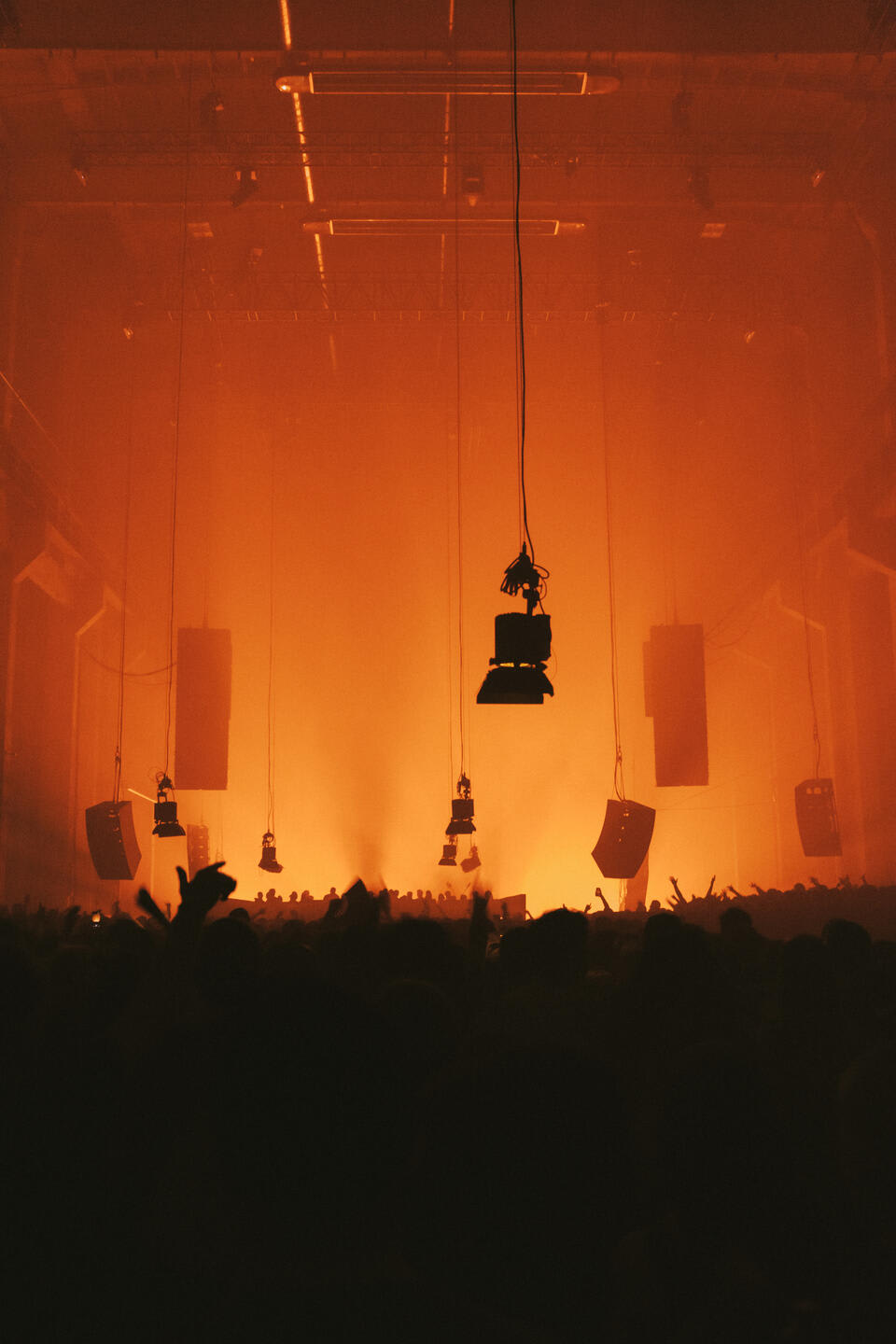
The launch of CONTRA is a testament to this. The platform underscores how Moore has always thought about music — boundless. In late May, the sounds that invaded the Kraftwerk complex ranged from raptor house by DJ Babatr and DJ RH deep in the caged recesses of Tresor to Lou Nour b2b Bakey shelling out UK bass on the Globus floor, with everything from Brazilian funk to amapiano to EDM in between. It's not a coincidence that Moore's cultural acceptance is coming at a time when dance music has had an influx of diverse voices, who are unafraid of working at the intersections of various genres and disciplines.
It's taken years of thankless groundwork from industry mavericks and adventurous curators to loosen Draconian conceptual constraints around music. In the era of social and decentralized media at large, the old guard's powers have waned. There is a simple yet prescient phrase Moore is oft-quoted repeating: "All boats rise with the water." Amid these changing tides, Skrillex is finally getting the warm welcome he's always deserved.

Whitney Wei is the editor-at-large of Electronic Beats.
Photos by: @mattiaxspich & @LENITAAAS